Onykia robsoni
Rugose clubhook squid
Described by Adam, 1952
Page authors: Michael Vecchione, Richard E. Young, Kotaro Tsuchiya, Tristan Strange, Kat Bolstad
Ventral view of a male Onykia robsoni from sub-Antarctic New Zealand waters. Photograph by Darren Stevens.
Onykia 'robsoni' is a Southern Ocean species complex that will probably resolve into at least three distinct species. This group is characterised by large body size (mantle length to at least 650mm), fins drawn out posteriorly into a tail, and round, blister-like 'warts' or papillae on the surface of the mantle.
Brief diagnosis: A large Onykia with sagittate fins and round, blister-like 'warts' or papillae on the surface of the mantle, and 13-16 hook pairs on the tentacle clubs.

Above: Tentacle clubs of Onykia robsoni (ML 260mm) from New Zealand. © Darren Stevens
Key morphological features:
- Fins sagittate, their length 53-62% of ML at 156-370 mm ML, their width 51-70% of ML at 156-370 mm ML
- Gladius with long rostrum (ventral length 23-36% of GL; triangular in cross-section)
- Tentacle hooks with deep lateral grooves on the cusp
This species is very similar to O. robusta in the shape of the fins but is separated by the structure of the skin (i.e., warts vs ridges), and the fewer pairs of club hooks (13-16 vs 16-18).

Above: 'Warts' or papillae on the mantle surface of a large Onykia robsoni (complex) specimen from New Zealand. © Darren Stevens
Live animal
Onykia robsoni is not known to have been filmed or photographed alive yet.
The type locality is off Angola at 16° 36'S, 11°20'E. This species complex occurs north of the southern subtropical convergence, off southwestern Australia, New Zealand and southern Africa, morphologically similar specimens have been taken from the Gulf of Mexico and off Bermuda in the North Atlantic (Kubodera et al. 1998). It is also reported off the southwestern coast of South America.
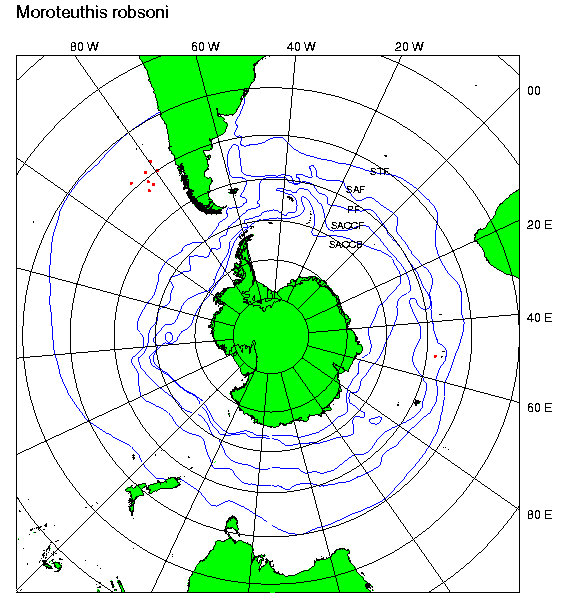
- Moroteuthis robsoni
- Adam, W. 1962. Cephalopodes de l’Archipel du Cap-Vert, de l’Angola et du Mozambique. Memorias da Junta de Investigacoes do Ultramar, series 2, 33: 9-64.
- T. Kubodera, U. Piatkowski, T. Okutani and M.R. Clarke. 1998. Taxonomy and Zoogeography of the Family Onychoteuthidae (Cephalopoda: Oegopsida). Smithsonian Contributions to Zoology, No. 586: 277-291.
Taxonomy
- Class
- Cephalopoda
- Superorder
- Decapodiformes
- Order
- Oegopsida
- Family
- Onychoteuthidae
- Genus
- Onykia