Chtenopterygidae
Page authors: Richard E. Young, Michael Vecchione, Michael J. Sweeney, Inés Rosales
Members of this family are small, muscular, midwater squids that occupy tropical to subtropical waters probably at depths of 500-1000m during the day and near-surface waters at night. The posterior end of the mantle is broadly rounded. The fins are peculiar: they consist of muscular pillars (fin ribs) connected by thin membranes giving the appearance of a comb (hence the family name). The fin extends nearly the full length of the mantle.
A number of undescribed species are present in this genus. Little is known of the biology of any species.
Brief diagnosis: A bathyteuthoid with fins extending along all of most of the mantle length, with muscular ribs.
Key morphological features:
- Buccal connectives attaching to ventral border of arms IV
Live animal:
Comb-like muscular supports in the fins clearly visible and sometimes darkly pigmented (see footage from Nautilus Live here).

Above: Chtenopteryx filmed near the seafloor by Nautilus Live at 1300m in the Mediterranean.
Three species are presently recognized in the family but more are known to exist:
Chtenopteryx canariensis (Salcedo-Vargas and Guerrero-Kommritz 2000)
Chtenopteryx sepioloides (Rancurel 1970)
Chtenopteryx sicula (Verany 1851)
- Combfin squid
- Chtenopterygidae (Grimpe 1922)
Many authors have spelled the genus name for this taxon "Ctenopteryx." However, Bello and Giannuzzi-Savelli (1993) documented that Appellof's original spelling (1890) was "Chtenopteryx." The spelling was changed by Joubin (1900) and this change was solidified as an emendation by Pfeffer (1900) who decided that the original spelling was in error because Appellof derived the generic name from the Greek words for "comb" and "wing." In addition to pointing out that Pfeffer's emendation was unjustified, Bello and Giannuzzi-Savelli (1993) noted that Guerra (1992) had found that the Pfeffer/Joubin spelling is a junior homonym of Ctenopteryx Flach, 1889, a coleopteran subgenus.Therefore, although Ctenopteryx may seem superficially to be the appropriate spelling for the squid genus, the actual correct spelling is Appellof's original.
Bello and Giannuzzi-Savelli (1993) further petitioned the International Commission on Zoological Nomenclature (ICZN) to place the name Chtenopterygidae Grimpe, 1922 on the Official List of Family-Group Names in Zoology and to place the name Ctenopterygidae Grimpe, 1922 on the Official List of Rejected and Invalid Family-Group Names in Zoology as an incorrect original spelling. These recommendations were accepted in ICZN Opinion 1793 (ICZN, 1995).
A list of all nominal genera and species in the Chtenopterygidae can be found below. The list includes the current status and type species of all genera, and the current status, type repository and type locality of all species and all pertinent references.
Nominal Genus-Level Taxa:
- (Note: type of locality of Calliteuthis nevroptera Jatta, 1896 needs verification}}
Chtenopteryx Appellof, 1890:3.
- CURRENT SYSTEMATIC STATUS. -- Valid genus [fide Bello and Giannuzzi-Savelli (1993:270)]
- TYPE SPECIES. -- Sepioteuthis sicula Verany, 1851 by subsequent synoymy of Chtenopteryx fimbriatus Appellof, 1890 by Pfeffer (1912:337)]
Ctenopteryx Appellof, 1890:4. [Emendation by Pfeffer (1900:171)]
- CURRENT SYSTEMATIC STATUS. -- Preoccupied by Coleoptera [fide Neave (1939:898)]; Chtenopteryx Appellof, 1890 [see Bello and Giannuzzi-Savelli (1993)]
Nominal Species-Level Taxa (As Introduced Binomial)
Chtenopteryx canariensis Salcedo-Vargas and Guerrero-Kommritz, 2000:32, figs 1-15.
- CURRENT SYSTEMATIC STATUS. -- Valid species [fide; taxon not yet reviewed]
- TYPE REPOSITORY. -- ZMH Holotype 2778 [fide Guerrero-Kommritz (2001:173)]
- TYPE LOCALITY. -- South of Canary Islands, 26°20'N, 019°21'W
Ctenopteryx siculus chuni Pfeffer, 1912:343.
- CURRENT SYSTEMATIC STATUS. -- Valid species?; Chtenopteryx chuni [fide Unresolved]
- TYPE REPOSITORY. -- ZMB Holotype Moll.-110005 [fide Glaubrecht and Salcedo-Vargas (2000:273)]
- TYPE LOCALITY. -- 28°28'S, 6°13'E (Atlantic Ocean)
Ctenopteryx cyprinoides Joubin, 1894:64, text-fig.
- CURRENT SYSTEMATIC STATUS. -- Chtenopteryx sicula (Verany, 1851) [fide Pfeffer (1912:332)]
- TYPE REPOSITORY. -- MOM Syntypes (3) [station 360]; not extant in the collections [fide Belloc (1950:6)]
- TYPE LOCALITY. -- Near Corsica, 42°10'N, 05°35'E, Mediterranean Sea (from stomach of dolphin)
Chtenopteryx fimbriatus Appellof, 1890:4, figs 1-6.
- CURRENT SYSTEMATIC STATUS. -- Chtenopteryx sicula (Verany, 1851) [fide Pfeffer (1912:337)]
- TYPE REPOSITORY. -- Type repository unresolved
- TYPE LOCALITY. – Messina
Calliteuthis nevroptera Jatta, 1896:118, pl 31.
- CURRENT SYSTEMATIC STATUS. -- Chtenopteryx sicula (Verany, 1851) [fide Voss (1969:858)]
- TYPE REPOSITORY. -- Type repository unresolved
- TYPE LOCALITY. -- Mediterranean [???]
Ctenopteryx sepioloides Rancurel, 1970:39, figs 26, 28-30.
- CURRENT SYSTEMATIC STATUS. -- Valid species; Chtenopteryx sepioloides [fide Nesis (1987:206)]
- TYPE REPOSITORY. -- MNHN? [fide Lu (pers. comm., Jan. 2000)]
- TYPE LOCALITY. -- Tuamotu Islands
Sepioteuthis sicula Verany, 1851:75, pl 27.
- CURRENT SYSTEMATIC STATUS. -- Valid species; Chtenopteryx sicula [fide Pfeffer (1900:172)]
- TYPE REPOSITORY. – Unresolved: MHNN? Holotype [other Verany taxa there fide G.L. Voss (pers. comm.)]
- TYPE LOCALITY. -- Messina [Italy] [fide Pfeffer (1912:337)]
Type Repositories
-
- MHNN- Museum d'Histoire Naturelle (Musee Barla), 60 bis blvd Risso, 06300 Nice, France.
- MNHN- Museum National d'Histoire Naturelle, Laboratoire Biologie Invertebres Marins et Malacologie, 55, rue de Buffon, 75005 Paris 05, France. [For type catalog see Lu et al. (1995)]
- MOM- Musee Oceanographique, Avenue Saint-Martin, Monaco-Ville, MC 98000, Monaco. [For type catalog see Belloc (1950)]
- ZMB- Zoologisches Museum, Museum für Naturkunde der Humboldt-Universitat, Invalidenstrasse 43, D-1040 Berlin, Germany. [For type catalog see Glaubrecht and Salcedo-Vargas (2000)]
- ZMH- Zoologisches Museum, Universitat Hamburg, Martin Luther King Platz 3, 2000 Hamburg 13, Germany. [For type catalog see Guerrero-Kommritz (2001)]
Vertical Distribution:
In Hawaiian waters relatively few captures were made during the daytime but they suggest that Chtenopteryx "sicula" occupies depths from about 600-1000 m while at night it migrates mostly into the upper 200m (Young, 1978).

Figure. Vertical distribution of C. "sicula" in Hawaiian waters. Captures were made with both open and opening/closing trawls. Bars- fishing depth-range of opening/closing trawl. Circle - Modal fishing depth for either trawl. Square - Middepth of tow while fishing when no modal fishing depth was apparent. Blue-filled circles - Night captures. Yellow-filled circles - Day captures. Chart modified from Young (1978).
Geographical Distribution:
Species of Chtenopteryx are found throughout the tropical and subtropical waters of the world's oceans (Nesis, 1982).
- Arms
- Dorsal six arms with suckers in six or more series at some point on arms.
- Buccal connectives attach to the ventral margins of arms IV.
- Tentacular club
- Suckers in 8 or more irregular series.
- Club ventrally expanded.
- Head
- Beaks: Lower beak and upper beak
- Lower Beak:
Oblique
view

Oblique
view
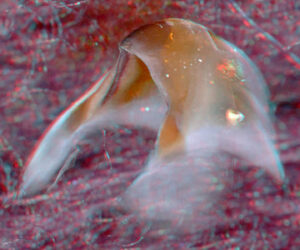

"Top"
view

Oral
view

Front
view

Posterior
oblique
view

- About anaglyph 3D: Photographs here are in 3D, using anaglyph techniques which combines two photographs one in red and the other in cyan (blue + green) color. To get the 3D effect, you must use glasses with red and cyan lenses (filters) over your regular glasses. The form of the beak is far easier to interpret in 3D and we strongly recommend to the viewer that the glasses be obtained (this is especially helpful when viewing enlarged images - i.e. click on the image). These beak photographs were made using Red and Cyan Anachrome Aviator Glasses (see: http://www.anachrome.com/glassbuy.htm or http://www.amazon.com) which cost under $10.00 (USD).
- Upper Beak:
Chtenopteryx sp., mature female, 54 mm ML, 1.0 mm LRL, central Pacific. Photographs by R. Young. Chtenopteryx sp., sex ?, ? mm ML, 1.2 mm LRL, Hawaiian waters. Photographs by R. Young.
Side
view

Oblique
view

Oblique
view

Oral
view

Top
view

Front
view

Posterior
oblique
view

- Fins
- Membranes connect slender muscle bundles (fin ribs) to produce comb-like appearance.
- Fins attach to lateral walls of mantle.
- Fins extend nearly full length of mantle in subadults.
- Photophores
- Large oval photophore on viscera (except in C. canariensis.
- Large photogenetic patches on eyeball (except in C. canariensis).
- Viscera
- Females with an accessory nidamental glands.
Comments:
Only a few species-level characters are known in Chtenopteryx. At present species are separated by (1) the maximum number of sucker series on the arms and tentacular clubs, (2) the presence/absence of photophores, (3) the size of the visceral photophore and (4) the mantle width relative to the ML.

Figure. Photograph of the visceral photophore of Chtenopteryx sp., off Hawaii by R. E. Young.
The visceral photophore present in some species is constructed somewhat like a car headlight with double reflectors. A silver central reflector bounces bioluminescent light back into the photophore and onto the larger basal reflector which directs the light out of the photophore. The red tissue beneath the photophore is the digestive gland. The intestine is transparent and can barely be seen passing over the surface of the photophore. In the title photograph above, the visceral photophore is visible through the transparent mantle.
Early paralarvae of Chtenopteryx spp. have distinctive tentacular clubs: Each club has a disc-shaped oral surface that is covered with suckers. Presumably some unusual, but unknown, function is associated with the odd shape of this club.

Figure. Oral view of the club of a 2.9 mm paralarva of Chtenopteryx sp. from the central North Atlantic. Scanning electron micrograph by Johnas Wright, provided by M. Vecchione.
Figure. Ventral view of a paralarva of Chtenopteryx sp., ca. 2-3 mm ML, off Hawaii. The disc-like clubs appear white in the photograph and face one another. This is the same species as illustrated below. Photograph by R. Young.
Paralarvae of two species of Chtenopteryx have been recognized in Hawaiian waters that differ in the chromatophore pattern on the distal end of the club. The more common form is illustrated below. Note that the fin ribs can just be detected in the smaller paralarva but the characteristic fins, although short, are clearly apparent in the larger paralarva. A distinctive feature of this species is the arrangement of chromatophores on the distal, aboral surface of the tentacle (arrow in illustration below).


Figure. Left - The thumbnail shows relative sizes of the two paralarvae. Right - Dorsal and ventral views of two sizes of paralarvae of Chtenopteryx sp. from Hawaiian waters. Left - 3.2 mm ML paralarva. Right - 5.4 mm ML paralarva. Drawings by R. Young. Scale bar is 1 mm.[/caption]
Behavior
Males of some species possess a large photophore that lies within the shell sac. Chtenopteryx sp. in a shipboard aquarium has been observed to produce a brilliant luminescent flash but the source of the flash could not be determined (pers. obs.). This squid has been observed, in an aquarium, to adjust the intensity of light emited from its visceral photophore in response to changes in an overhead light (pers. obs.). This behavior is consistent with counterillumination (concealment via matching the downwelling light with bioluminescence) but the animal, in a horizontal attitude, did not conceal itself effectively as the head and posterior third of the body were relatively dark against the overhead light (ie, these regions cast shadows).
Appellof, A. 1890. Teuthologische Beitrage. I. Chtenopteryx n.g., Veranya sicula Krohn. Calliteuthis Verrill. Bergens Museums Aarsberetning. 1889(33):1-34.
Bello, G. and R. Giannuzzi-Savelli. 1993. Case 2874. Chtenopteryx Appellof, 1890 (Mollusca, Cephalopoda): proposed confirmation as the correct original spelling. Bulletin of Zoological Nomenclature. 50(4):270-272.
Belloc, G. 1950. Catalogue des types de Céphalopodes du Musée Océanographique de Monaco. Bulletin de l'Institut Océanographique, 970:1-10.
Glaubrecht, M. and M.A. Salcedo-Vargas. 2000. Annotated type catalogue of the Cephalopoda (Mollusca) in the Museum für Naturkunde, Humboldt University of Berlin. Mitteilungen aus dem Museum für Naturkunde Berlin, Zoologischen, 76(2):269-282.
Grimpe, G. 1922. Systematische ubersicht der europaischen Cephalopoden. Sitzungsberichte der Naturforschenden Gesellschaft zu Leipzig, 45:36-52.
Guerra, A. 1992. Mollusca, Cephalopoda. Fauna Iberica, Vol. 1 327 pp. Museo Nacional de Ciencias Naturales, CSIS, Madrid.
Guerrero-Kommritz, J.G. 2001. Catalogue of the cephalopod type specimens in the Zoological Museum Hamburg. Mitteilungen. Hamburgisches Zoologische Museum and Institut, 98:171-174.
ICZN. 1995. OPINION 1793. Chtenopteryx Appellof, 1890 (Mollusca, Cephalopoda):confirmed as the correct original spelling. Bulletin of Zoological Nomenclature.52(1):96-97.
Jatta, G. 1896. I. Cefalopodi viventi nel Golfo di Napoli (Sistematica). Fauna und Flora des Golfes von Neapel, 23:1-268, 64 figures, 31 plates.
Joubin, L. 1900. Cephalopodes provenant des campagnes de la Princesse-Alice (1891-1897). Resultats des Campagnes Scientifiques accomplies sur son yacht par Albert Ier Prince Souverain de Monaco. 17:1-135.
Joubin, L. 1894. Note sur les Céphalopodes recueillis dans l'estomoc d'un Dauphin de la Méditerranée. Bulletin de la Societe Zoologique de France, 19:61-68, 1 figure.
Neave, S.A (editor) 1939. Nomenclator Zoologicus. Zoological Society of London, 4 volumes, London.
Nesis, K. N. 1982. Abridged key to the cephalopod mollusks of the world's ocean. 385+ii pp. Light and Food Industry Publishing House, Moscow. (In Russian.). Translated into English by B. S. Levitov, ed. by L. A. Burgess (1987), Cephalopods of the world. T. F. H. Publications, Neptune City, NJ, 351pp.
Nesis, K.N. 1987. Cephalopods of the World; Squids, cuttlefishes, Octopuses, and Allies. T.F.H. Publications, Neptune City, NJ, USA, 351 pages.
Okutani, T. 1974. Epipelagic decapod cephalopods collected by micronekton tows during the EASTROPAC expeditions, 1967-1968 (systematic part). Bull. Tokai Reg. Fish. Res. Lab., 80: 29-118.
Pfeffer, G. 1900. Synopsis der oegopsiden Cephalopoden. Mitteilungen aus dem Naturhistorischen Museum in Hamburg. 17:145-198.
Pfeffer, G. 1912. Die Cephalopoden der Plankton-Expedition. Zugleich eine monographische ubersicht der Oegopsiden Cephalopoden. Ergebnisse der Plankton-Expedition der Humboldt-stiftung, 2:1-815, 48 plates.
Rancurel, P. 1970. Les contenus stomacaux d'Alepisaurus ferox dans le sud-oust Pacifique (Cephalopodes). Cahiers O.R.S.T.O.M., (series Oceanographique)8(4):1-87, 41 figures, 3 plates.
Salcedo-Vargas, M.A. and J. Guerrero-Kommritz. 2000. Three new cephalopods from the Atlantic Ocean. Mitteilungen. Hamburgisches Zoologische Museum and Institut, 97:31-44, 25 figures.
Vérany, J.B. 1851. Céphalopdes de la Méditerranée. Mollusques Méditerranéens Observes, Decrits, Figures et Chromolithographies a apres le vivant ouvrage dedii ASM le roi Charles Albert, I:1-132, 41 plates.
Voss, N.A. 1969. A monograph of the Cephalopoda of the North Atlantic. The family Histioteuthidae. Bulletin of Marine Science, 19(4):713-867, 37 figures.