Species of Planctoteuthis are usually rather small and very fragile deep-sea squids that are often badly damaged during capture. As a result, few species have been described. Unlike other chiroteuthids, the subadult retains the peculiar doratopsid paralarval tentacular club. Roper and Young (1967) suggest that Planktoteuthis is a neotenic doratopsis.
Diagnosis
A chiroteuthid ...
- with antitragus but no tragus in oval funnel locking-apparatus.
- with a compact club not divided into proximal and distal regions by structure of protective membranes.
- with arms IV bare except for proximal quarter.
- without funnel valve.
- without photophores.
-
- Arms
- Subequal in length in adults; arms IV much the longest in young.
- Arms IV with relatively few suckers in the proximal 1/3 of arm or less, remainder of arm without suckers. Suckers usually aligned in virtually single series.The reason for the peculiar structure of arms IV is unknown. The following images provides clues to this problem. These photographs show the bases of arms IV, presumably the sucker-bearing region, locked together. The tentacles (arrows in 1st and 3rd photos, in the 2nd photo, the tentacles have curlicue ends) emerge, adjacent to one another, from the joined arms IV . Apparently the proximal, sucker-bearing region of arms IV, and their lateral membranes, form a single tentacular sheath for holding both tentacles. The value of this arrangement and the function of the bare, distal arms IV is unknown. Also, the coiling of the tentacles suggests that they are not strongly retractile.
- Arms
 |
 |
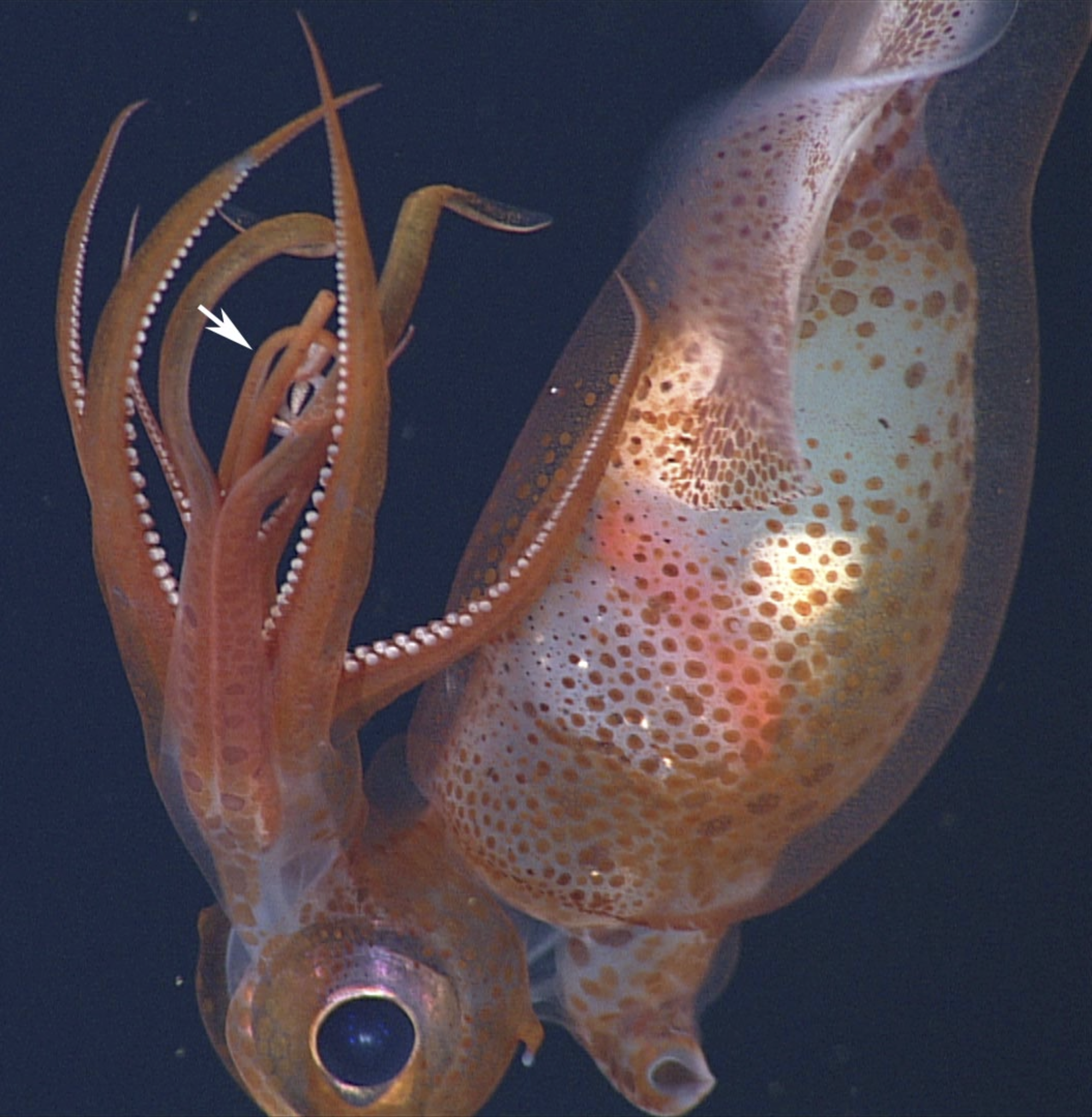 |
Left, middle - Slightly different anterodorsal views of the same squid, 1206 m depth.
Right - Side view of a different, probably larger squid, ? depth. This species has 12-13 suckers on the proximal third of arms IV. All three photographs © 2013 MBARI.
- Tentacles
- Club small, compact.
- Club keel absent in some species.
- Club without carpal locking apparatus.
- Low protective membranes/ridges along both boarders of club.
- Not divided into proximal and distal regions by protective membranes.
 Figure. Oral view of tentacular club of Planctoteuthis lippula, Hawaiian waters, 35 mm ML. Photograph by R. Young.
- Head
- Head with elongate neck and brachial pillar.
- Eyes commonly project ventrally from head.
 Figure. Lateral view of head of Planctoteuthis lippula, Hawaiian waters, 35 mm ML. Photograph by R. Young.
- Funnel
- Funnel valve absent.
- Funnel locking apparatus oval with posterior bump (antitragus) (see Comments).
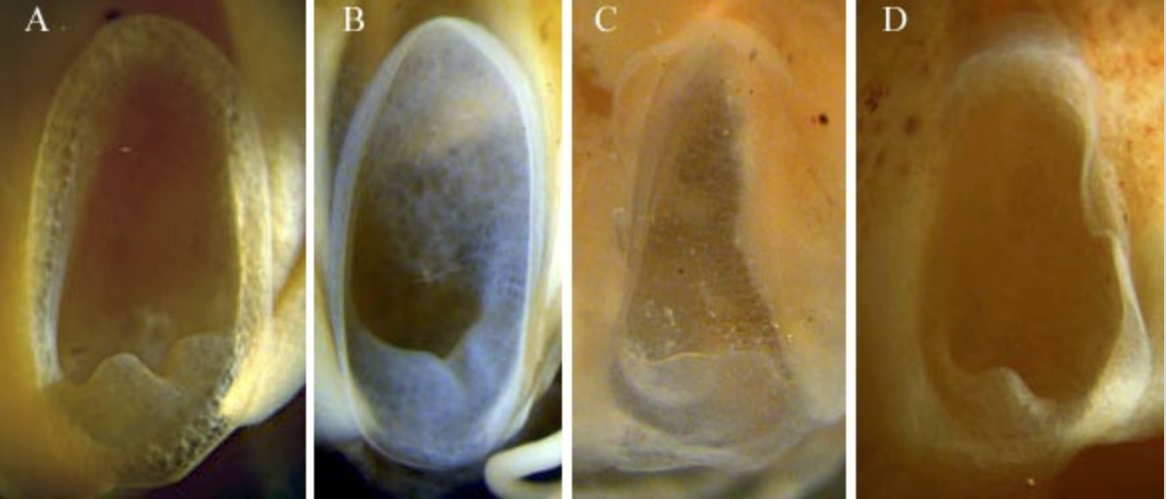
- The exact form of the antitragus in the funnel locking-apparatus is often a species-specific feature. Unfortunately this structure is difficult to see and lighting and angle of view can often give different apparent results. The character must be used cautiously. Compare the locking apparatuses of the following species:

Figure. Funnel component of the funnel/mantle locking apparatus of various species of Planctoteuthis. A - P. danae. B - P. levimana, 60 mm ML. C - P. lippula, 55 mm ML. D - P. oligobessa. Photographs by R. Young.
- Photophores
- Absent.
- Tail
- Tail present (usually lost during capture) with appendages. Appendages undescribed.
Comments
The exact form of the antitragus in the funnel locking-apparatus is often a species-specific feature. Unfortunately this structure is difficult to see and lighting and angle of view can often give different apparent results. The character must be used cautiously. Compare the locking apparatuses of the following species:

Figure. Funnel component of the funnel/mantle locking apparatus of various species of Planctoteuthis. A - P. danae. B - P. levimana, 60 mm ML. C - P. lippula, 55 mm ML. D - P. oligobessa. Photographs by R. Young.
The species are compared in the following table.
| Arm IV suckers, number | Arm sucker dentition, arm I-III | Antitragus | Fin length | Club shape | Club keel | Distribution | |
| P. danae | 12-13 | 7-9 distal truncated teeth | Double. Lobes nearly equal | 52% ML | Symmetrical | No | Trop. Pacific |
| P. exopthalmica = P. levimana? | 10 | ? | ? | width=36% ML | Symmetrical | No | S. Indian |
| P. levimana | 6-8 | Broad truncate teeth all around | Double. Lobes unequal | 40% ML | Long, symmetrical | No | N. Atlantic, Trop. Pacific |
| P. lippula | 25 | >50 minute teeth, distal larger | Single or slight double. Low, broad | 40-45% ML | Short, Asymmetrical | Yes | Atlantic, Trop. Pacific |
| P. oligobessa | 2-4 | 25-35 blunt teeth, distal 2/3 | Single. Slender | 23-33% ML | Symmetrical | No | Trop. Pacific |
The type species, Planctoteuthis danae, was originally placed in a new genus, Valbyteuthis, within a new family, Valbyteuthidae, by Joubin (1931). Roper and Young (1967) placed Valbyteuthis in the family Chiroteuthidae noting the similarity of Valbyteuthis paralarvae to those of Chiroteuthis. Young (1991) recognized that some paralarvae of Valbyteuthis had been previously descibed by Pfeffer (1912) as members of his new genus, Planctoteuthis, within the Chiroteuthidae. Valbyteuthis, therefore is a junior synonym of Planctoteuthis.
Lower mesopelagic to bathypelagic depth distribution within tropical to temperate oceans of the world.
The doratopsis paralarva of Planctoteuthis can be recognized by:
- Strong ventral projection of eyes.
- Few suckers on arms, tentacles (young doratopsis).
- Relatively small, tapering tentacles (young doratopsis).
- Reduced vesicular region on mantle (young doratopsis).
Descriptions of paralarvae are found in pages on Planctoteuthis lippula and P. danae.
Joubin, L. 1931. Notes preliminaires sur les Cephalopodes des croiseires du "Dana" (1921-1922). Annales de l'Institut Oceanographique, 10: 169-211.
Pfeffer, G. 1912. Die Cephalopoden der Plankton-Expedition. Ergebniss der Plankton-Expedition der Humboldt-Stiftung. 2: 1-815.
Roper, C. F. E. and R. E. Young. 1967. A review of the Valbyteuthidae and an evaluation of its relationship with the Chiroteuthidae. Proc. U.S. Nat. Mus. 123: 1-9.
Young, R. E. 1972. The systematics and areal distribution of pelagic cephalopods from the seas off Southern California. Smithson. Contr. Zool., 97: 1-159.
Young, R. E. 1991. Chiroteuthid and related paralarvae from Hawaiian waters. Bull. Mar. Sci. 49: 162-185.