Species of Teuthowenia are moderate-sized (140-380 mm gladius length), midwater cranchiids. Each species occupies a separate region of the world's oceans where primary productivity is relatively high. Paralarvae occupy near-surface waters until they reach a relatively large size of 50-100 mm ML.
Figure. Lateral view of T. megalops in the "cockatoo" posture. Video still frame from a videotape recorded in-situ (Vecchione and Roper, 1991), JOHNSON SEA-LINK I submersible dive 2141; 4 August 1987; New England; depth = 789 m; temp. = 4.8° C; ML = 137 mm.
A taoniin ...
- with three photophores on eyeball.
- with anterior third of fins attaching to mantle.
A taoniin ...
- with three photophores on eyeball.
- with anterior third of fins attaching to mantle.
As per Voss (19850, the three species appear to have non-overlapping distributions (see below). Teuthowenia megalops occupies the subarctic and temperate waters of the north Atlantic Ocean. Teuthowenia maculata is found in the tropical waters of the eastern Atlantic Ocean. Teuthowenia pellucida occupies circum-global waters in the region of the subtropical convergence in the southern hemisphere.
Figure. Red-filled circles- Teuthowenia megalops; yellow-filled triangles- Teuthowenia maculata. T. megalops occupies the subarctic and north temperate regions of the North Atlantic. T. maculata occupies the tropical Eastern Atlantic and, especially the Mauritanian Upwelling Region off the eastern buldge of Africa.
Figure. Red-filled circles - Teuthowenia pellucida. T. pellucida is found circumglobally along a narrow belt that lies in the region of the Southern Subtropical Convergence.
Maps modified from Voss, 1985. pp. 26, 56. Printed with the permission of the Bulletin of Marine Science.
- Tentacles
- Club with suckers.
- Stalk with four series of suckers and pads in distal 1/2 to 2/3.*
Figure. Oral view of tentacle-cub of T. pellucida, 140 mm ML. Drawing from Voss (1985, p. 43. fig. 12g).
- Funnel
- Funnel valve absent.
- Funel organ: Dorsal pad with three papillae.
Figure. View of funnel organ of T. maculata, 123 mm ML. Drawing from Voss (1985, p. 33, fig.8f).
- Mantle
- Tubercles present (1-4) at funnel-mantle fusion.
Figure. Ventral view of tubercule at funnel-mantle fusion of T. maculata, 123 mm ML. Drawing from Voss (1985, p. 33, 8e).
- Fin
- Anterior third or more inserts on mantle (in subadults) rather than shell-sac of gladius.***
Figure. Ventral view of the fin of T. megalops, showing fin shape. Photograph by M. Vecchione.
- Photophores
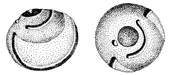
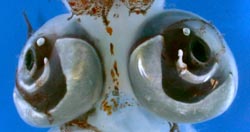
- Three photophores on each eye.**
- Photophores present on all arm tips of mature females.
⚠ ToL source
 width="169"/> ⚠ ToL source
 width="250"/>
Figure. Left - Ventral and lateral views of an eye of T. maculata, 123 mm ML, showing ocular photophores. from Voss (1985, p. 33, fig. 8c,d). Right - Ventral view of the eyes of T. megalops, 134 mm ML, North Atlantic. Photographed during the MarEco cruise on the R/V G. O. SARS by R. Young.
*Unique in family but see Bathothauma and Megalocranchia.
**Unique in family.
***Unusual in family; shared with Egea.
Comments
Characteristics are from Voss (1980).
The best known species is T. pellucida. Juveniles begin an ontogenetic descent reaching bathypelagic depths as adults where they mate and spawn. Peculiar glands develop on the mantle of females at maturity that may produce a pheromone (Voss, 1985). In the dark, spacious waters of the bathypelagic zone locating a mate can be difficult. Presumably the production of a chemical attractant (pheromone) combined with the luminescence provided by the arm-tip photophores solves this problem. During mating discharged spermatophores (spermatangia) attach to the dorsal surface of the female then penetrate through the mantle wall and apparently discharge sperm into the mantle cavity (Voss, 1985). Females apparently spawn once then die.
- Vecchione, M. and C. F. E. Roper. 1991. Cephalopods observed from submersibles in the western North Atlantic. Bulletin of Marine Science 49(1-2):433-445.
- Voss, N. A. 1980. A generic revision of the Cranchiidae (Cephalopoda; Oegopsida). Bull. Mar. Sci. 30: 365-412.
- Voss, N. A. 1985. Systematics, biology and biogeography of the cranchiid cephalopod genus Teuthowenia (Oegopsida). Bull. Mar. Sci. 36: 1-85.
- Young, Richard E. and Katharina M. Mangold (1922-2003). 2006. Teuthowenia Chun, 1910 . Version 16 July 2006. http://tolweb.org/Teuthowenia/19560/2006.07.16 in The Tree of Life Web Project, http://tolweb.org/